


The Georgia Guidestones: Mystery, Legacy, and the Enduring Nature of Granite
For more than 40 years, the Georgia Guidestones stood in a rural field near Elberton, Georgia. Their massive granite panels and mysterious origins attracted visitors, sparked debate, and made them an unusual landmark. Although the monument no longer stands, its story remains part of Elberton’s granite heritage and offers a thoughtful perspective on how we preserve a legacy.
A Monument Built Around a Mystery
Unveiled on March 22, 1980, the Guidestones consisted of six granite elements weighing more than 230,000 pounds. Four upright panels displayed ten guidelines in eight languages, while a central stone and capstone completed the structure. Carefully designed openings and alignments also allowed the monument to function as an astronomical calendar and clock.
The project was commissioned by a man using the pseudonym “R. C. Christian,” who said he represented a group of Americans. He worked with the Elberton Granite Finishing Company to bring the design to life. The identities behind the project have never been conclusively established publicly.
The inscriptions addressed humanity’s relationship with nature, governance, and the future. Together with the monument’s anonymous origins and unusual design, they drew visitors and sustained public interest for decades.
A Showcase of Elberton Craftsmanship
Beyond their unusual message, the Guidestones represented a substantial achievement in granite fabrication. Quarrying, shaping, transporting, and assembling stones of that scale required skilled workers and careful planning.
Elberton has long been a center of America’s granite industry, supplying stone for memorials, monuments, and public projects. The Guidestones offered a distinctive example of the region’s craftsmanship, bringing together monumental construction, detailed engraving, and precise alignment.
The Monument’s Destruction and Lasting Story
On July 6, 2022, an explosion destroyed part of the monument. Authorities demolished the remaining structure later that day because of safety concerns, bringing its four decades on the landscape to an abrupt end.
Its history, however, remains documented in photographs, books, videos, and personal accounts. The Guidestones illustrate how a monument can become part of a community’s story, even after the physical structure is gone.
At OM Stone, our Oregon roots and fabrication shop in Elberton connect us to this stone-working tradition. We value Georgia Gray granite for its durability, natural beauty, and engraving qualities.
The Guidestones remain a fascinating chapter in Elberton’s granite heritage, reflecting the skill and vision involved in creating a lasting monument. For those choosing a memorial today, the connection is personal: thoughtfully selected stone and careful craftsmanship can help preserve a loved one’s name, story, and memory for future generations.
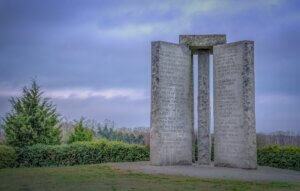
Georgia Guidestones. Photo by Dina Eric (ViryaKala), via Wikimedia Commons (CC BY-SA 2.0).